How Dover’s Local Institutions Shape Its Fall Season
October 1, 2026
Every fall fixture on the town calendar this year is run by an institution that was already here, doing something else, twelve months ago.
That's the thing worth understanding if you live in Dover and have only ever half-noticed the fall calendar. The Trustees of Reservations aren't a seasonal vendor. They're the nonprofit that has run Powisset Farm as a working farm year-round. The Dover-Sherborn High School Cross-Country Team isn't a race promoter. They're a school sports team that happens to organize a 5K once a year to fund their own program. DoverRec isn't an events company. It's the town parks department doing what parks departments do, just with a Halloween playlist attached. Nobody in Dover had to build fall from scratch. They just pointed their existing institutions at October and let them run.
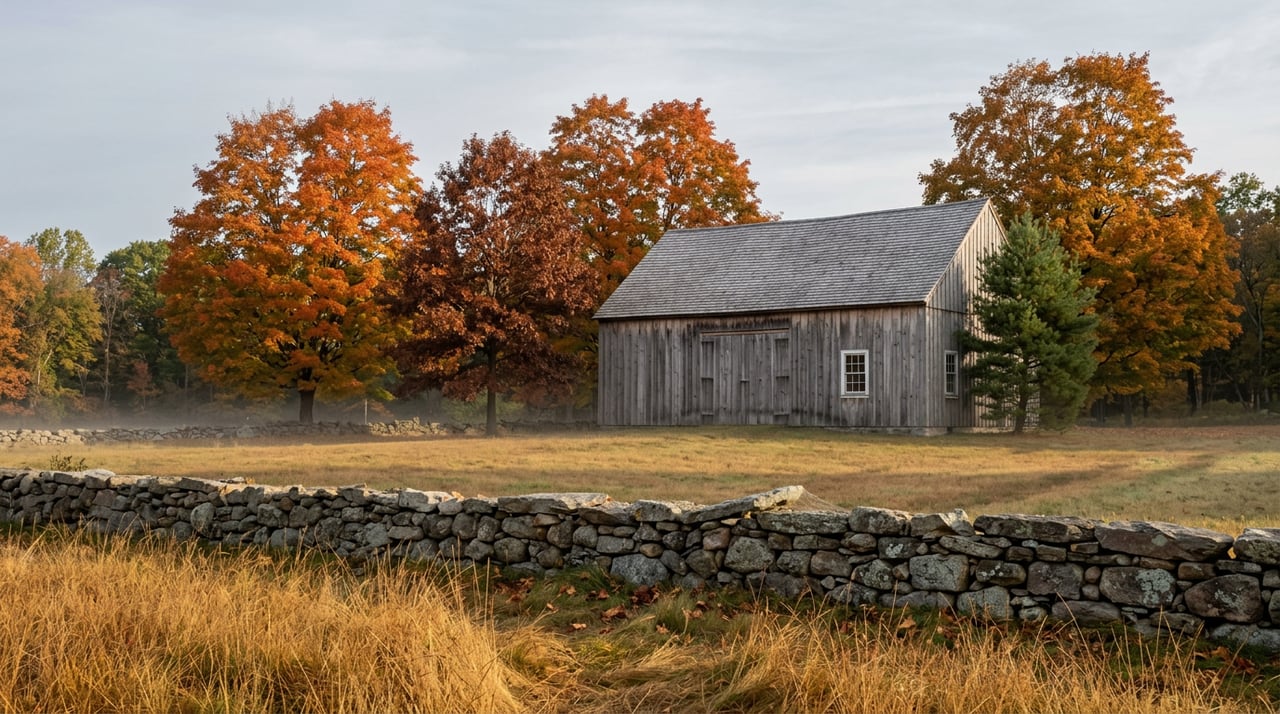
Powisset Farm sits at 37 Powisset Street, and it's been under Trustees of Reservations stewardship as a functioning farm long before anyone turned it into a race course. Visitors can walk the farm lane past barnyard animals and rows of vegetables and herbs any day of the year, sunrise to sunset, for free. The trail run is something the farm added on top of what it already does, not a reason for the farm to exist.
That trail run is the Powisset Farm Trail Run, the fall edition of the Barn to Run Trail Race Series, scheduled for Sunday, October 25, 2026. It starts and ends near the main barn, opens with a flat, grassy Meadow Loop through the farm's own hayfields and rock walls, then sends the longer distances (3.1, 5.6, and 8.6 miles) across the street into Noanet Woodlands, where the terrain shifts to hard-packed dirt, loose gravel, and exposed roots. Runners in the two longest races climb Noanet Peak, a 387-foot rise that gives a clear view of the Boston skyline before dropping back down. Cider donuts wait at the finish, along with pumpkin painting for kids who came to watch.
The detail that says the most about how this event fits into Dover: dogs aren't allowed on Powisset Farm's cultivated land, because the property runs an active electric deer fence around its fields. If you want to walk a dog before or after, you cross the street to Noanet Woodlands instead. That's not a rule written for tourists. That's a rule written for a working farm that happens to let the public in.
Dover Days Fair lands on the second Saturday of September every year, which put the 2026 edition on September 12, just before this post went up. It's easy to think of it as a generic town fair, but the specifics tell a more local story. Food during the day comes from Dover Legion Post 209 and Chubb's Ice Cream Truck, both of which are fixtures at the fair site rather than vendors trucked in for the occasion. Overflow food and drinks come from Dover Market and the Dunkin' just beyond the Legion, both walkable from the fair grounds. Recent editions of the fair have doubled as a venue for civic milestones too, including a Community Center ribbon-cutting folded into the day's schedule. It was never just a repeat of the year before.
The fair also has a built-in rain date, the Sunday after, decided the Friday evening before by Dover Parks and Recreation. That's a small operational detail, but it tells you this is a town-run event with a town-run contingency plan.
Paired with the fair each year is the Dover Dash 5K and Fun Run, which starts and ends in front of the Dover American Legion. The event isn't outsourced to a race management company. It's coordinated and run by the Dover-Sherborn High School Cross-Country Team itself, with proceeds supporting youth running programs. Walkers and baby strollers are explicitly welcome, which keeps it a community event rather than a competitive one, and finishers walk straight from the course into the fair that's already underway.
It's a small structural choice that says something about how Dover organizes its year. The same kids who run cross-country meets for their school in the fall also run a public 5K to fund that program, on the same morning the town holds its biggest civic gathering. Nothing here required a new organization. It just required handing a familiar group one more job.
Later in the month, DoverRec turns the Town Common into a Halloween afternoon with a DJ-led playlist, pumpkin decorating, musical contests with small prizes, and goodie bags. It's capped by advance registration, and once the spaces fill or the DoverRec office closes for the week, that's it. A separate Trunk-or-Treat event follows the same registration model. They're parks department programming sized to the number of families who actually live in town.
The fall calendar's last fixture is a Thanksgiving tradition that ties two towns together rather than just one. DoverRec runs a flag football event for kids at Chickering Fields, timed to build toward the Dover-Sherborn versus Medfield Thanksgiving Day football game, a rivalry both towns treat as an institution in its own right. Players get picked up from school after an early release, walk together to Chickering Fields, eat lunch as a group, and then play. It's the same logic as everything else on this list: an existing rivalry, an existing field, an existing half-day of school, reassembled into one more piece of the season rather than invented for it.
Line these up and a pattern holds that's easy to miss if you only attend one event a year. Dover's fall isn't a season the town buys. It's a season the town's existing institutions produce as a byproduct of doing their regular jobs slightly differently in October and November. A conservation nonprofit that farms the land adds a race. A high school team that runs meets adds a fundraiser 5K. A parks department that programs the Common all year adds a Halloween afternoon. A football rivalry that already exists gets a flag football warmup for kids.
Dover's fall calendar reflects work by institutions that are already active in town. Its events build on activities those organizations carry out beyond the fall season.
If you're weighing what makes a town feel settled versus assembled, this is a useful thread to pull. It's the same texture that shows up across the towns Francis Curran works in, from Dover down through Medfield and Westwood, where local institutions help shape the local calendar.
If you're thinking about Dover, or any of the towns nearby, and want a conversation grounded in what actually makes a place function day to day, not just what the listing photos show, Francis Curran is a straightforward way to start that conversation. Let's Connect.
Stay up to date on the latest real estate trends.
Providing clients with ultimate bespoke representation, customized marketing strategy, and a culture built on service. Excelling in exceeding expectations for buyers and sellers.
Start the Conversation

692 HIGH STREET WESTWOOD, MA 02090