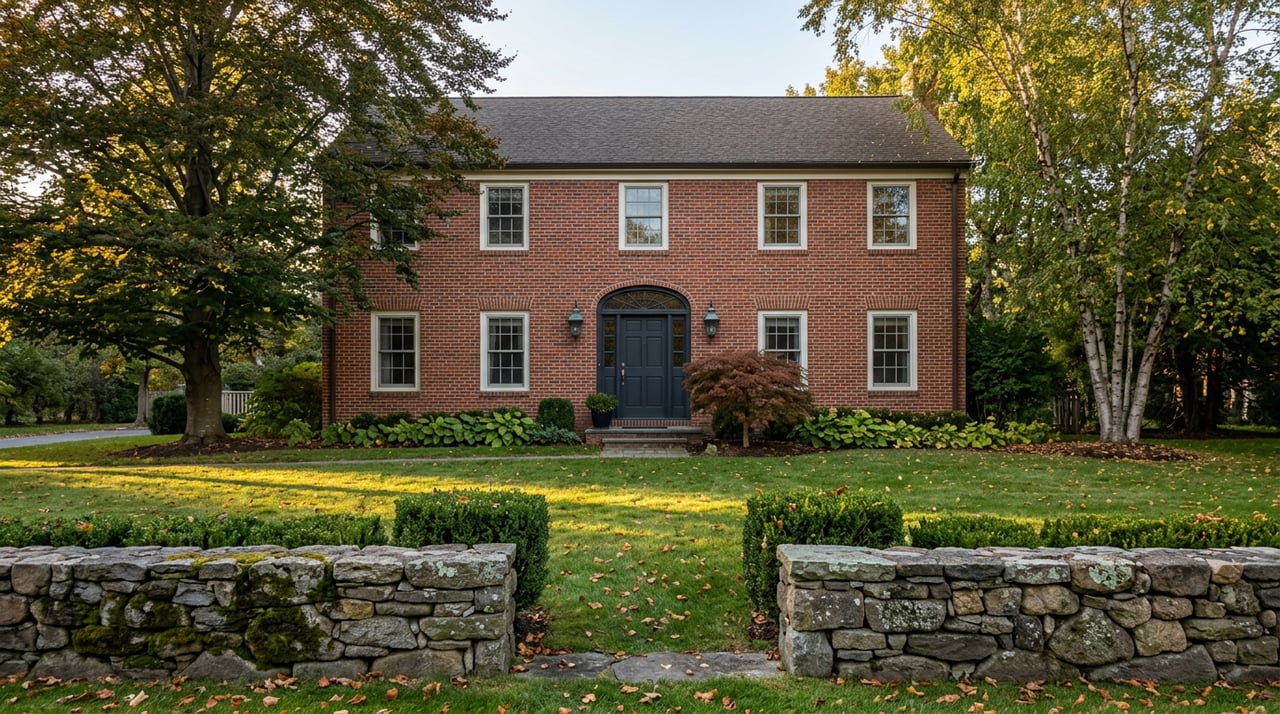
Medfield and Dover Share the Same Commute. Only One Costs $700,000 More.
September 24, 2026
September 24, 2026
Ask a buyer why Dover costs more than Medfield and most will guess the train. It is the obvious answer for two towns fifteen minutes apart in Norfolk County. One must have a station the other doesn't, and that difference must be worth something on paper.
Neither town has a commuter rail station. Medfield lost its stop, Medfield Junction, in 1967, when passenger service on the old West Medway Branch was discontinued for good. Dover has never had one within its own borders. Residents of both towns drive to catch a train, and yet Dover's average home value sat at roughly $1,799,000 in July 2026 according to Zillow's home value index, against Medfield's median single-family sale price of $1,085,000 over the twelve months ending that same month. That's a gap of nearly $714,000 between two towns with an identical answer to "how do I get to South Station."
If rail access isn't the variable, something else is doing the work. It turns out to be zoning, and understanding it changes what a buyer should actually be comparing when the two towns show up on the same shortlist.
Medfield's nearest working commuter rail stations are in Walpole and at Norwood Central, both on the Franklin Line, both roughly a fifteen-minute drive from the town common. Dover residents make a similar drive to reach a station outside town lines. Neither town offers a walk-to-the-platform option, and neither has fought to get one back. The MBTA Communities Act, the 2021 state law requiring municipalities near transit to zone for more multi-family housing, treats towns differently based on whether they have a commuter rail stop inside their boundaries. Dover's own planning documents work through the law's multi-family unit and density requirements without ever pointing to an in-town station, because there isn't one to point to.
So the commute variable is a wash. A household choosing between the two towns is choosing the same drive-to-the-train reality either way. That should mean the price gap comes from something else entirely, and it does.
Dover's zoning bylaw is built to keep lots large and the built environment sparse, and the mechanics are specific enough to matter for a buyer's math. Three provisions in particular do the structural work:
None of these rules mention transit. They mention trees, stone walls, and acreage. Stacked together, they mechanically cap how much housing can exist on a given piece of Dover land and preserve the large-lot, low-density character the town is known for. Scarcity built that way holds its value the same as scarcity built by a subway stop, and it explains a price premium that has nothing to do with anyone's commute.
Medfield's zoning runs a looser mix. The town's older neighborhoods around North and South Main Street sit on tighter Colonial and Cape lots dating to the 1890s through the 1950s, walkable to Park Street Books & Toys and Blue Moon Bagel Café on the town common. Newer construction has been landing at the more affordable edge of town: an eight-home development in Edgewood, bordering Millis, began delivering homes in spring 2026 with prices starting around $1.4 million, sitting above the town's broader median because it reflects new-construction pricing rather than the older resale mix that still makes up most of Medfield's sales.
Here is the detail that should settle the argument. Westwood, unlike Medfield or Dover, actually has its own commuter rail stops: Islington on the Franklin Line and Route 128 on the Providence/Stoughton Line. By the rail-access theory, Westwood should command the highest prices of the three towns. It doesn't. Westwood's average home value ran roughly $1,258,000 in July 2026, per Zillow, putting it only about $173,000 above Medfield and more than half a million dollars below Dover.
A town with its own train stations prices closer to a town with none than to a town that also has none. That's the strongest evidence that lot-size zoning, not transit, is setting the ceiling in Dover. If rail access were the swing factor, Westwood would be the outlier at the top. Instead it's the town in the middle, and Dover, the one with no station at all, is the one asking the most.
For a buyer running this comparison seriously, the practical takeaway isn't which town has better transit access. It's which zoning environment matches what they actually want to own.
Medfield buys a real downtown. Blocks you can walk, an independent bookstore, a bagel shop that functions as the town's unofficial Saturday gathering spot, and a town common that gets used rather than just mowed. Lots run smaller and older homes need more updating, which is where a buyer's inspection budget and a clear sense of renovation ROI matter more than they would on a newer property.
Dover buys acreage, tree cover, and the kind of privacy that comes from a town actively working to preserve both. That premium is real and it's structural, protected by the same zoning provisions that keep the town from ever looking like anywhere else in Norfolk County.
Westwood buys a middle path: two working train stations, a town center in Islington that has been steadily adding new storefronts, and pricing that sits closer to Medfield's than to Dover's despite the transit advantage. For a buyer who wants rail access without paying Dover-level premiums for it, Westwood is worth a serious look alongside Medfield rather than as a separate search entirely.
None of this makes one town the objectively better buy. It does mean a buyer comparing median prices across these three towns is comparing three different zoning philosophies, not three different commute times.
Does Medfield have any public transit at all? Bus route 34E connects Medfield to nearby stops, but there is no passenger rail service within town lines. The town's own rail history ended in 1967 when service on the West Medway Branch was discontinued.
Why does Dover regulate something as specific as tree removal? The Scenic Road bylaw is meant to preserve the stone walls and mature tree cover that define the town's rural character along its designated roads. It functions as a zoning tool as much as an aesthetic one, since it limits how easily a lot can be cleared and reconfigured for denser building.
Is Westwood a reasonable compromise for someone who wants both character and a train station? Based on July 2026 pricing, Westwood sits closer to Medfield than to Dover while offering its own commuter rail stops at Islington and Route 128, which makes it worth comparing directly against Medfield rather than treating the search as Medfield versus Dover alone.
If you're weighing Medfield against its neighbors and want to know what a specific property's lot, zoning district, or renovation potential actually means for its value, that's a conversation worth having before you write an offer. Francis Curran has spent decades reading these towns block by block, and a home valuation is a good place to start putting real numbers behind the comparison. Let's Connect.
This article is general information, not legal, tax or financial advice. Consult a qualified professional about your situation.
Stay up to date on the latest real estate trends.
Providing clients with ultimate bespoke representation, customized marketing strategy, and a culture built on service. Excelling in exceeding expectations for buyers and sellers.
Start the Conversation

692 HIGH STREET WESTWOOD, MA 02090