Wellesley's MBTA Zoning Got Its First Taker on Laurel Avenue. The Bigger Project Skipped It Entirely
October 15, 2026
October 15, 2026
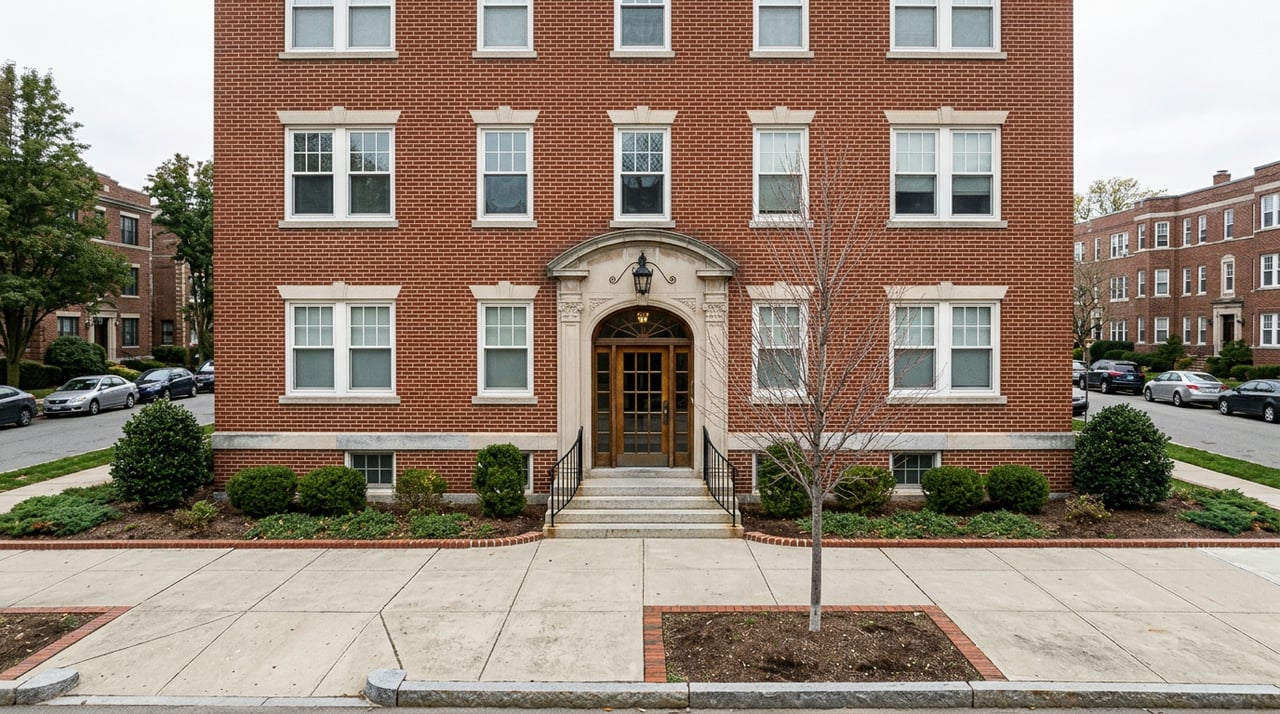
There's a chain-link fence around 16 Laurel Avenue in Wellesley Hills right now, wrapped around a one-time multi-tenant office building that a developer is converting into 28 condominiums. It's the first project in Wellesley to actually use the multi-family zoning the town created in 2024 to comply with the state's MBTA Communities Law, according to The Swellesley Report.
A few blocks away, near Wellesley Square, a second condo project cleared its final town approval this spring. Nineteen units on the site of the old Waterman Funeral Home, next door to The Belclare. According to the Project of Significant Impact decision, that parcel qualified for the same by-right zoning as Laurel Avenue. Its developer didn't use it. He went through Wellesley's oldest, slowest, most scrutinized permitting track instead, a process called Project of Significant Impact, because that track let him build more units than the "reform" zoning would have allowed. That single decision tells you more about how density actually gets built in Wellesley than the town's compliance status ever will.
The Laurel, as the developer's renderings label it, sits on the opposite side of Washington Street from the Wellesley Hills commuter rail station, near Le Petit Four Bakery. The original structure dates to the early 1900s, built by Roger Babson, the founder of Babson College, and renovated once already in 2001. The current plan keeps the exterior largely intact while adding density inside and up: four stories, 28 units, six of them income-restricted under a state affordability formula. The developer's own timeline has crews breaking ground this summer, with an estimated 18 months to finish, which would put a realistic delivery somewhere in late 2027 or into 2028.
592 Washington Street is a different kind of building working toward a similar outcome by a completely different route. The three-story project replaces the former funeral home, built in 1911, and was designed by McKay Architects of Dedham for developer Dean Behrend. Of its 19 units, four will be affordable and 15 market rate, all in the same building. A traffic study submitted to the town estimated the project would generate only 16 to 20 peak-hour vehicle trips, well under the 50-trip threshold that normally triggers this level of scrutiny, according to Citizen Portal. The project cleared that heavier review anyway, not because its traffic demanded it, but because the developer wanted a special permit for density greater than what the MBTA-compliant zoning on that parcel would allow.
This is the part that doesn't show up in a zoning map. The Project of Significant Impact process is the deliberate, case-by-case track.
At 592 Washington, using the MBTA-compliant zoning would have meant building fewer units than the town's own Wellesley Square Commercial District bylaw allows through its Section 5.2 special permit path. So the developer chose the slower, harder route on purpose, because it had a higher ceiling. The zoning built to unlock supply wasn't the fastest way to more units on that lot. It was the older, discretionary bylaw the state law was partly designed to move around.
If you're trying to guess where new housing will land in a town like Wellesley by checking whether it's "MBTA compliant," that checkbox doesn't tell you which permitting track a given developer will actually use, or how many units will come out the other end.
Wellesley's obligation under the law was to zone capacity for 1,392 units within a half mile of its stations, with 90 percent of that capacity concentrated near the transit area itself, according to the town's own explanation of the requirement. Capacity is not construction. A town can meet its number on paper and still see the actual building activity happen somewhere else, through a different bylaw entirely, the way it's happening at 592 Washington.
For a buyer weighing Wellesley against Newton, Needham, or a town further out on the line, the useful question isn't whether a town complied. Most towns near Boston's rail network have by now. The useful question is which corridor, and which specific parcels, have active filings in front of a Planning Board or Zoning Board of Appeals right now, because that's the only reliable signal of what a street will look like in three years. Wellesley Hills is producing moderate new density through the path the state intended. Wellesley Square is producing it through the path the state was partly trying to route around. Both are adding condos near a train station. Neither would show up as different on a compliance map.
Single-family homes in Wellesley have averaged $2.56 million across 82 closed sales so far this year, up from $2.34 million over the same stretch last year. Condominiums have moved in the opposite direction: an average of $1.13 million across 15 closed sales this year, down from $1.59 million a year earlier. Condos are also taking longer to find a buyer, a median of 47 days to offer versus 33 for houses, and closing slightly under list price, 98.7 percent versus 100.9 percent for single-family homes.
Fifteen closings is a small enough sample that one or two lower-priced sales can swing the average on their own, so this isn't proof of a falling condo market in any broad sense. But it is the kind of thin, easily-moved number that makes a still-unbuilt pipeline matter more than it would in a deeper market. Forty-seven new condo units, between the two projects, are working through construction financing and permitting a few blocks from each town center, on a rough timeline that could bring meaningful new inventory to market within two to three years. In a segment where 15 sales make up the entire year-to-date picture, that's not a rounding error.
Does the MBTA Communities Law mean Wellesley has to keep adding multi-family housing? The law required Wellesley to zone for capacity. Whether an owner or developer actually builds to that capacity, or chooses a different bylaw altogether the way 592 Washington's developer did, is decided project by project.
When will these units actually be available to buy? Neither project has a confirmed delivery date. The Laurel's developer has targeted a summer 2026 groundbreaking with roughly 18 months to complete construction. 592 Washington received its final Project of Significant Impact approval from the Planning Board this spring and still has site work and construction ahead of it.
Reading a town's zoning compliance the way most portals present it, as a single checkbox, misses exactly the kind of detail that changes what a corridor looks like in a few years. If you're weighing Wellesley against another MetroWest town, or you own property near either of these projects and want to think through timing, Francis Curran has spent decades tracking how permitting decisions like these actually play out on the ground here. Start with a look at current values on the home valuation page, browse other towns on the neighborhoods page, or just reach out. Let's Connect.
This article is general information, not legal, tax or financial advice. Consult a qualified professional about your situation.
Stay up to date on the latest real estate trends.
Providing clients with ultimate bespoke representation, customized marketing strategy, and a culture built on service. Excelling in exceeding expectations for buyers and sellers.
Start the Conversation

692 HIGH STREET WESTWOOD, MA 02090